

Currently Online: 50
You have just registered your Singapore agency, your first retainer client wants Google Ads, and the platform wants a payment card. For a Singapore agency, recharging client advertising costs raises Goods and Services Tax (GST) and cash-flow questions. Contracts and conduct affect GST treatment; payment timing affects working capital.
Every agency lands on one of three structures. The client can own the platform account and pay it directly; the agency can buy the media as principal and recharge it; or the agency can pay as a disclosed agent, recovering the exact cost. The hypothetical example below produces the same client outlay under each structure. The GST invoices, supporting evidence and registration turnover can differ.
Our team would review the structure before the first fee note goes out. Changing it mid-engagement can require changes to billing profiles, invoices and contracts.
In this blog, we discuss how the three structures work, how the Inland Revenue Authority of Singapore (IRAS) tells a reimbursement from a disbursement, what your invoices and files should show, and how payment timing squeezes your cash. We write from the daily work of helping founders set up and run Singapore companies; the figures below are illustrative, and nothing here is tax advice for a specific engagement.
Table of Contents
Why Does It Matter Who Pays for Client Advertising Spend in Singapore?
Key takeaways:
- Contracts and conduct determine GST treatment; payment timing affects cash flow.
- IRAS looks beyond invoice wording alone.
- Client-paid accounts are a proposed starting point, not a confirmed practitioner endorsement or a rule for every platform.
- Principal media recoveries may count towards taxable turnover, depending on the supply.
For a Singapore agency, the choice of who pays client advertising costs is commercial as well as tax-driven, because an advertising cost recharge can carry GST and cash-flow consequences. These hypothetical structures assume a GST-registered agency making standard-rated supplies. Confirm platform terms, access permissions, billing, contracts and conduct before applying them. Each structure carries its own paperwork.
If you have not yet incorporated, the guides on the Setup Company Singapore homepage walk through Accounting and Corporate Regulatory Authority (ACRA) registration and the filings that follow; you can also review the billing structure at the same time.
1. Direct payment: the client owns the platform account
In this hypothetical workflow, the client contracts with and pays the platform. The agency manages the campaign through delegated access and invoices its management fee. Client-paid accounts may be a practical starting point, but this is a proposed commercial judgement, not a confirmed practitioner endorsement. Confirm platform terms, access permissions and billing arrangements.
2. Principal recharge: you buy the media in your own name
In this hypothetical workflow, the agency purchases media in its own right and supplies an agreed service to the client. The recovery may form part of that supply. GST applies at 9% if the agency is registered and the supply is standard-rated, even without a markup. Input GST may be claimable subject to the applicable conditions. Actual contracts and conduct determine the analysis.
3. Paying agent: the client stays the platform's customer
In this hypothetical workflow, the client remains the platform's customer and legal debtor. The agency pays under authority and seeks to recover the exact amount. A qualifying disbursement is outside the agency's GST calculation, and the agency cannot claim input GST on the client's supply. Confirm the authority, platform terms, invoices and actual conduct before applying this treatment.
How Does IRAS Decide Principal Versus Agent for a Recharge?
IRAS decides on the underlying purchase and the parties' conduct, not on your invoice wording, a zero markup or whose payment card was used.
The distinction that matters is between a reimbursement and a disbursement. IRAS guidance on reimbursement and disbursement first asks who received the platform's supply. It distinguishes a principal's cost recovery from a qualifying payment made on the client's behalf.
A reimbursement may be consideration for your own supply, taxable at 9% where your agency is registered and the supply is standard-rated; a compensatory recovery with no supply in return is not subject to GST. A qualifying disbursement sits outside it: the client, not you, received the supply; the exact amount recovered is not a supply; and no GST attaches to it.
Where the picture is unclear, IRAS calls for the principal-versus-agent indicators to be weighed objectively, on balance. Usual indicators include the client's responsibility for the charge, knowledge of the supply and authorisation of your payment. The client receives the supply, and you recover the exact amount separately from your fee. Not every indicator must be present, and no single invoice line is decisive.
A separate line for advertising costs charged at cost does not settle the question. Treatment follows contract and conduct. Where documents conflict — a client agreement that says 'agent' while the platform's terms name your agency as the customer — resolve the conflict before you bill, not after.
Three Structures for Client Advertising Spend Compared
| Structure | Who contracts with the platform | What you bill the client | Typical GST position |
|---|---|---|---|
| Direct payment | The client | Your management fee plus GST on the fee | No media line on your invoice; no GST or input claim on media |
| Principal recharge | Your agency | Media recharge plus your fee, with GST on both | Recharge forms part of your taxable supply; input GST may be claimable, subject to conditions |
| Paying agent | The client, paid by your agency under written authority | Exact cost recovered as a disbursement, plus your fee with GST | Disbursement sits outside your GST calculation; no input claim on the platform invoice |
What Would a S$10,000 Media Recharge Look Like on Paper?
This worked example is entirely hypothetical. A Singapore GST specialist should review it before use; no reviewer has approved the draft.
Assume a Singapore client and a GST-registered agency making standard-rated supplies. Monthly media spend is S$10,000 and the management fee is S$1,500, both before GST. Assume the platform issues a valid Singapore tax invoice charging 9% GST. All amounts are in Singapore dollars, and every figure below is hypothetical: actual platform entities, billing profiles and GST treatment must be verified before you copy any line.
Under direct payment the client pays the platform S$10,900 and you bill S$1,635. As principal you pay the platform S$10,900 and bill S$12,535 with GST on both elements. As paying agent you settle the client's S$10,900 bill, recover it without GST, and add your fee plus GST — the same S$12,535 total, but three different evidence stories.
Contract wording should match the workflow. A principal clause states that the agency purchases advertising inventory in its own name and supplies the agreed services to the client. A paying-agent clause states that the client appoints the agency solely as its disclosed paying agent for authorised platform charges, remains liable for them, and that the agency recovers only the exact amount paid. Neither clause can override contrary platform terms or actual conduct.
Principal Versus Agent: Reimbursement or Disbursement?
| Question | Reimbursement (you are principal) | Disbursement (you are paying agent) |
|---|---|---|
| Who receives the platform's supply? | Your agency | Your client |
| Is the recovery part of your supply? | Yes — it is consideration for your service | No — it is outside your GST calculation |
| GST on the recovery | Charge 9% where you are registered and the supply is standard-rated | None on the exact amount recovered |
| Input GST on the platform invoice | May be claimable, subject to conditions | Not claimable — the supply belongs to your client |
| Key evidence | Your platform contract and client agreement | Client-named invoice, written authority and payment proof |
What Evidence Should You Keep for Every Media Recharge?
Our team proposes assembling the documents below before billing to assess the arrangement.
This proposed review method is not a claim that any particular document pack has been examined. Treat each item as evidence of who really contracted with the platform, and record your conclusion beside it.
1. Platform terms and billing profile
Establish the actual supplier, customer and legal debtor from the accepted platform terms, the billing profile and the invoice itself — not from the campaign's brand name or who holds the login.
2. The signed engagement letter
Does your agency promise its own advertising service, or an authorised payment on the client's behalf? Responsibility for overspend, cancellation and refunds belongs in writing.
3. The relevant party's platform invoice and your payment proof
Keep the platform invoice addressed to the relevant party and your payment proof. Reconcile every recovery against them. Retained platform credits should be reconciled too: recovering the full invoice amount while keeping a credit makes an exact-cost recovery hard to defend.
4. Both parties' GST status
Record registration status and the applicable treatment. Local advertising supplies are generally standard-rated; qualifying international advertising services may be zero-rated where the conditions are met, and overseas platforms can raise overseas-vendor registration or reverse-charge questions. Cross-border points deserve specialist review.
5. A separate financial-reporting note
Your accountant should identify the applicable Singapore financial reporting standard and assess principal-versus-agent presentation on its own terms. An accounting label never establishes the GST treatment, and the GST analysis never settles the accounts.
Illustrative Invoice Lines for a S$10,000 Media Recharge
| Workflow | Platform invoice | Your bill to the client | Client's total outlay |
|---|---|---|---|
| Direct payment (day 1) | S$10,900 to the client | S$1,500 fee + S$135 GST = S$1,635 | S$12,535 |
| Principal recharge (day 30) | S$10,900 to your agency | S$10,000 media + S$1,500 fee + S$1,035 GST = S$12,535 | S$12,535 |
| Paying agent (day 30) | S$10,900 to the client, paid by your agency under authority | S$10,900 disbursement + S$1,500 fee + S$135 GST = S$12,535 | S$12,535 |
How Does Paying the Platform First Affect Your Cash Flow?
It funds your client's media: paying on day 1 and collecting on day 45 means you bankroll the campaign, whoever is the platform's customer.
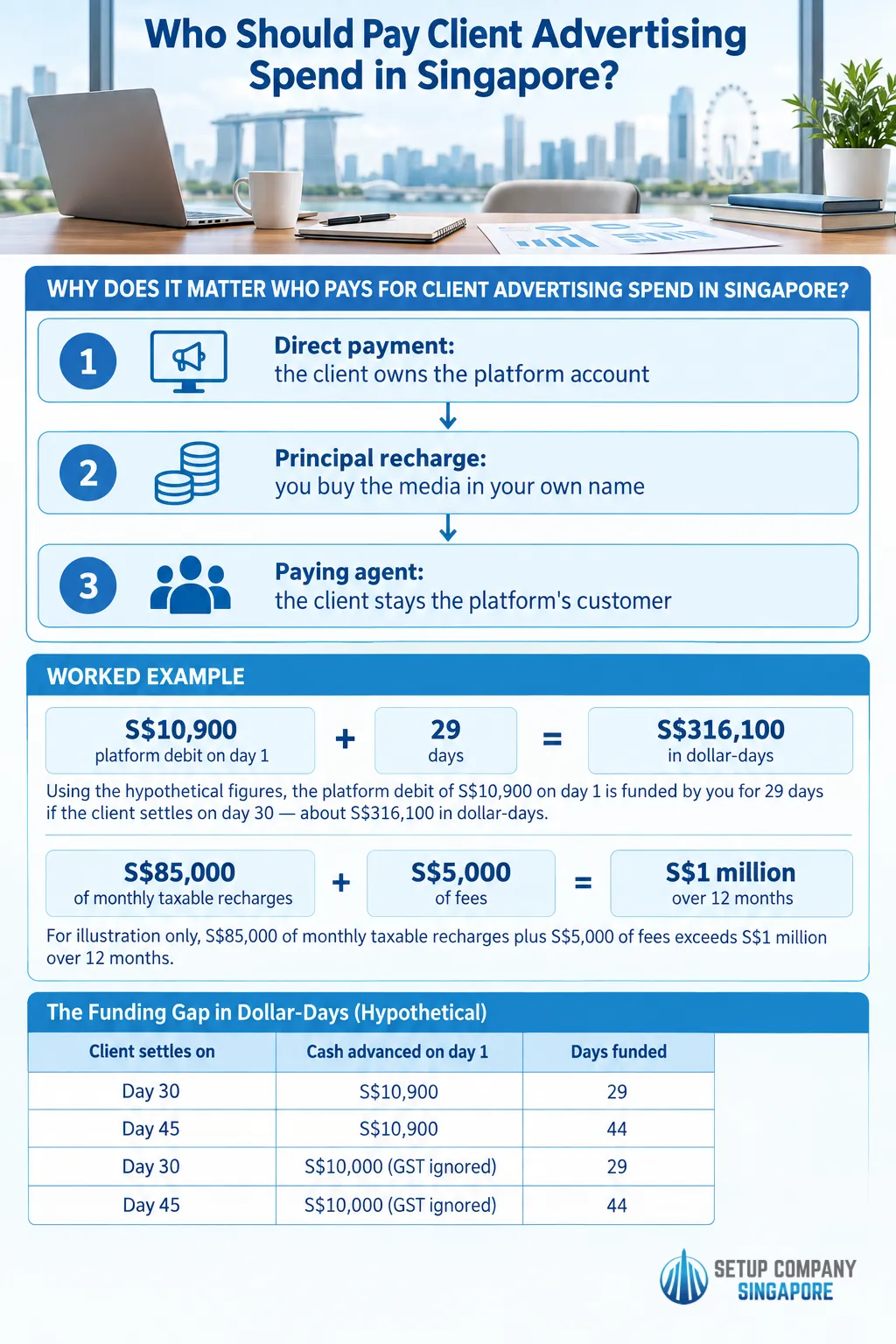
Using the hypothetical figures, the platform debit of S$10,900 on day 1 is funded by you for 29 days if the client settles on day 30 — about S$316,100 in dollar-days. A day-45 client stretches that to 44 days and about S$479,600.
Dollar-days measure the amount and duration of funding, not a loss or an interest charge. Overlapping advances can strain reserves if another platform payment falls due before the first receipt clears. An eventual input-GST credit is not cash in the bank on payment day.
The fixes are commercial, not clever. Direct platform payment removes the gap entirely; cleared funds held on account before spend removes most of it. Note that funding a client's platform account in advance improves cash flow but does not, by itself, establish agency status — the contract and the evidence do that.
The Funding Gap in Dollar-Days (Hypothetical)
| Client settles on | Cash advanced on day 1 | Days funded | Dollar-days funded |
|---|---|---|---|
| Day 30 | S$10,900 | 29 | S$316,100 |
| Day 45 | S$10,900 | 44 | S$479,600 |
| Day 30 | S$10,000 (GST ignored) | 29 | S$290,000 |
| Day 45 | S$10,000 (GST ignored) | 44 | S$440,000 |
When Should You Review Who Pays Your Client's Media Spend?
Our team proposes client-owned, client-paid accounts as a possible starting point for new agencies. Review the structure when cash, contracts or turnover change. This is an unconfirmed commercial judgement, not a rule for every platform or client.
These are the moments when we would sit down with an agency client and re-run the numbers. Each is a commercial control, not a legal threshold, and the timing is a matter of judgement rather than a statutory trigger.
1. The media you fund grows
When agency-funded spend grows past the level your reserves comfortably carry, move clients to direct payment or require cleared funds before the month's spend goes live.
2. Client payment terms stretch
A client paying well after the platform's own billing cycle converts your service margin into an interest-free loan. Tighten the funding arrangements before the next campaign, not after it.
3. A new platform or billing change appears
New platform terms, a changed billing entity, a reduced card limit or a withdrawn platform credit can all change the analysis. Review the structure before the first invoice under the new terms.
4. GST registration comes into view
IRAS generally requires registration when taxable turnover exceeds S$1 million under the retrospective calendar-year test. It also applies a prospective test when you reasonably expect turnover to exceed S$1 million in the next 12 months. Exceptions and other registration regimes may apply. For prospective liability arising on or after 1 July 2025, IRAS states that registration takes effect two months after the date the forecast is made, although the application remains due within 30 days. Media recharges that form part of your supplies count towards the tests; genuine disbursements do not. For illustration only, S$85,000 of monthly taxable recharges plus S$5,000 of fees exceeds S$1 million over 12 months. That assumption alone does not establish a registration date.
5. The papers disagree or borders are involved
Conflicting contracts and invoices, input-tax questions, or a classification that could change your registration obligations: escalate to a Singapore GST specialist. Our team proposes this safeguard; it is not a statutory requirement to appoint a specialist.
Conclusion
So, who pays for client advertising spend in Singapore? Our team proposes direct client payment as a possible starting point, with the agency billing its own fee. This is an unconfirmed commercial judgement, not a rule for every platform. Check the platform terms and revisit the arrangement as circumstances change. IRAS will look past your invoice labels to the contracts and conduct underneath.
We support agency founders with incorporation, bookkeeping, GST registration, payroll and subsequent filings. ACRA charges S$300 for company registration and S$15 for a name application under its 2026 fee schedule. Its annual return filing fee is S$60. The corporate income tax return for Year of Assessment 2026 is due by 30 November 2026, where filing is required.
If you would like a second pair of eyes on your billing structure before the next retainer signs, we would be glad to help. Bring your platform terms, a sample invoice and your draft engagement letter, and we will walk through them together.
Review Your Agency's Billing Structure
Talk to Setup Company Singapore about incorporation, GST registration and a media-billing setup that protects your cash flow.
Frequently Asked Questions
No. IRAS looks at the underlying purchase and the parties' conduct, not the label. A disbursement only qualifies if conditions such as the client's responsibility for the charge, written authorisation and recovery of the exact amount are genuinely met.
No — as a paying agent you cannot claim input GST on a supply made to your principal. If you buy the media as principal, an input claim may be possible, but it depends on the usual supporting documents and conditions, not the tax invoice alone.
If the recharge forms part of your taxable supply, yes — the usual result when you buy media as principal. A genuine disbursement is not a supply and does not count. IRAS applies both a retrospective calendar-year test and a prospective 12-month test, with the application due within 30 days of liability.
Our team proposes direct client payment as a possible starting point for a new agency. It avoids agency-funded media, but it is an unconfirmed commercial judgement, not a rule. Platform terms, credit arrangements and client preferences may support another structure.
Keep the platform invoice addressed to your client, proof of your payment, the written authority to pay, and a reconciliation showing you recovered exactly what you paid. Record both parties' GST registration status alongside the file.

Setup Company Singapore
Author
Setup Company Singapore explains how to start and run a business in Singapore and helps founders and foreign entrepreneurs with company incorporation and corporate services.