
New founders often overlook filing requirements for a Singapore company with no revenue. A private limited company with zero sales must still file its ACRA annual return, but its first IRAS return depends on when it closes its accounts and whether it commenced business or received income.
The Accounting and Corporate Regulatory Authority (ACRA) expects an annual return even if the company qualifies as dormant. The Inland Revenue Authority of Singapore (IRAS) generally expects a corporate income tax return, subject to filing waivers and first-year rules. Meanwhile, a founder paying start-up costs personally creates records that need proper accounting treatment.
Getting this wrong is costly. IRAS warns that late or non-filing of a corporate income tax return can attract penalties of up to S$5,000. Dormancy, exemptions and waivers each have their own tests, and none of them is triggered by the absence of sales alone.
In this blog, we discuss the filing and record-keeping duties of a no-revenue company, how dormancy is assessed separately by ACRA and IRAS, and how founder-paid start-up expenses are treated for tax. We use a worked example from incorporation to the first tax return.
Table of Contents
Key Takeaways: Filing Duties for a Singapore Company With No Revenue
No sales does not switch off the compliance calendar. Here is what matters most for a first year with no revenue in Singapore.
- A non-listed company files its ACRA annual return within seven months of its financial year end, even if dormant.
- ACRA and IRAS apply separate dormancy tests. A few dollars of bank interest makes a company non-dormant for IRAS.
- Estimated Chargeable Income (ECI) is due within three months of year end. The ordinary waiver needs both revenue of S$5 million or less and nil ECI.
- The corporate income tax return is due by 30 November each year. Companies required to file a YA 2026 return must do so by 30 November 2026; a company incorporated in 2025 that closed its first accounts that year but neither commenced business nor received income does not need to file for YA 2026.
- Incorporation costs are capital in nature and not deductible. Qualifying pre-commencement revenue expenses may be deductible once business commences.
- Keep tax records at least five years from the relevant Year of Assessment (YA) and accounting records at least five years after the financial year ends.
Does a Company With No Revenue Still Have to File?
Yes. Filing duties arise from incorporation and the Companies Act 1967, not from making sales.
A non-listed private company must lodge an annual return with ACRA through the Bizfile portal, and IRAS generally expects a corporate income tax return, subject to filing waivers and first-year rules. Even a company that qualifies as dormant still files the annual return.
The precise obligations depend on your company's facts and any applicable exemption or waiver. In our practice, the pattern that causes trouble is a first year with no sales but plenty of activity: incorporation costs, a founder's advance and a little bank interest. None of that counts as 'nothing'.
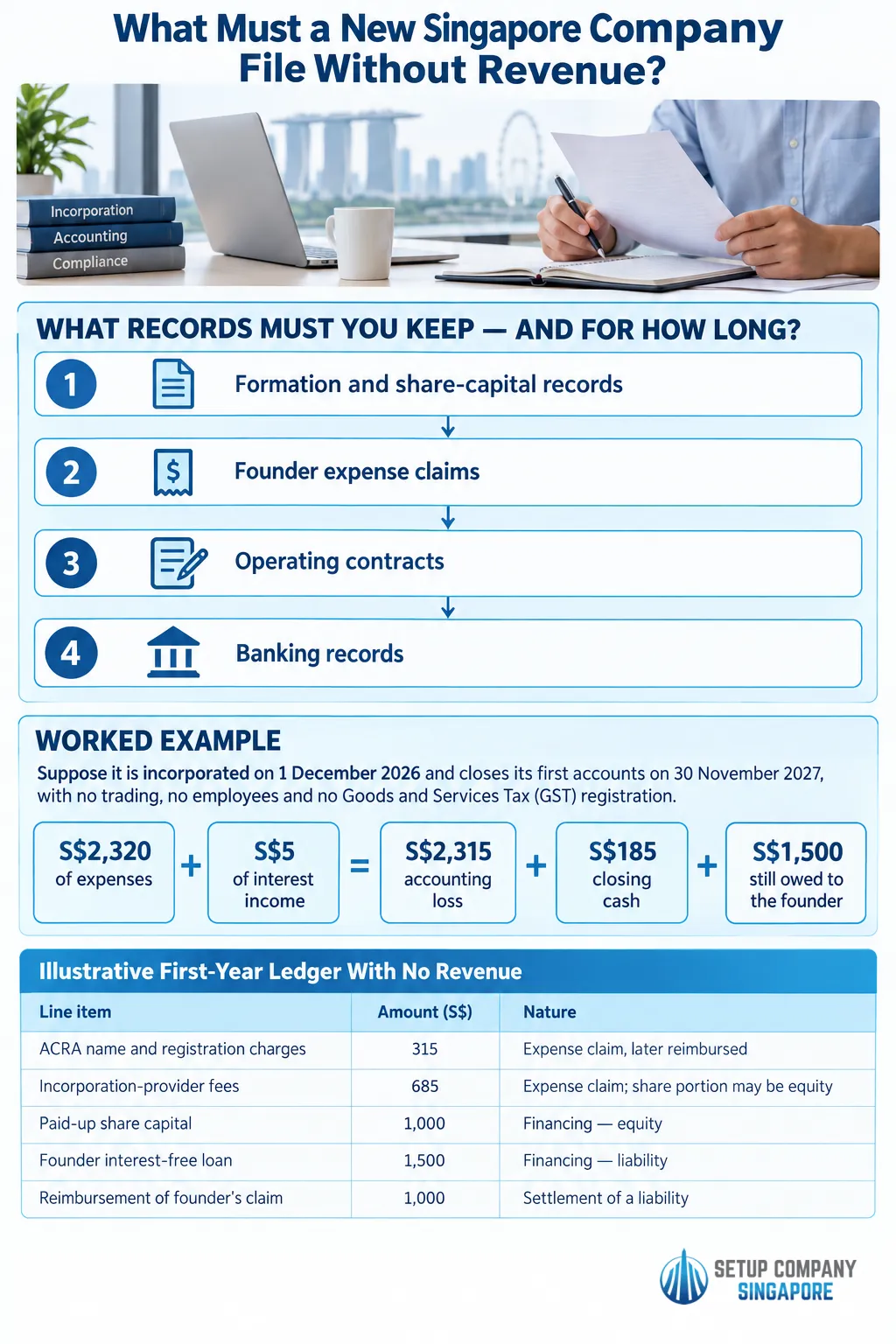
To make the duties concrete, we will use a hypothetical company throughout this article. It is a constructed example, not a client ledger. Suppose it is incorporated on 1 December 2026 and closes its first accounts on 30 November 2027, with no trading, no employees and no Goods and Services Tax (GST) registration.
The founder personally pays S$315 of ACRA charges — the S$15 name application plus the S$300 registration fee — and S$685 of incorporation-provider fees. Within the S$685, assume S$100 relates specifically to issuing the initial shares. The company accepts the S$1,000 claim as money owed to the founder and reimburses it. The shareholder subscribes S$1,000 of paid-up capital, and the founder advances a separate S$1,500 interest-free loan.
During the year, the company pays S$600 for company secretarial services, S$360 for its registered office and S$240 for a software subscription. Bank charges total S$120, and the account earns S$5 of interest on the final day of the year.
That produces S$2,320 of expenses, S$5 of interest income, an accounting loss of S$2,315, closing cash of S$185 and S$1,500 still owed to the founder. Treat these figures as illustrative: your accountant must approve the final ledger. The S$100 share-issue element may also be equity rather than expense under your reporting framework, which would change the loss.
Illustrative First-Year Ledger With No Revenue
| Line item | Amount (S$) | Nature |
|---|---|---|
| ACRA name and registration charges, paid by founder | 315 | Expense claim, later reimbursed |
| Incorporation-provider fees (S$100 share issuance within) | 685 | Expense claim; share portion may be equity |
| Paid-up share capital | 1,000 | Financing — equity |
| Founder interest-free loan | 1,500 | Financing — liability |
| Reimbursement of founder's claim | 1,000 | Settlement of a liability, not a second expense |
| Company secretarial services (annual) | 600 | Operating cost |
| Registered office (annual) | 360 | Operating cost |
| Software subscription | 240 | Operating cost |
| Bank charges (monthly) | 120 | Operating cost |
| Bank interest credited | 5 | Income |
| Totals: expenses 2,320; interest 5; loss 2,315; closing cash 185; owed to founder 1,500 | — | Illustrative; accountant to approve |
How Do ACRA and IRAS Decide Whether a Company Is Dormant?
ACRA looks for accounting transactions, while IRAS looks at business activity and income — so a company can pass one test and fail the other.
Neither authority treats the absence of sales as an answer. A company can pass one test and fail the other, so the two assessments must be run separately.
For ACRA, we look for accounting transactions and then apply the statutory exclusions. Subscriber share-taking, specified company-maintenance transactions and Registrar fees can fall outside the dormancy test. In practice we examine the incorporation invoice line by line rather than assume the whole package is excluded.
On the example above, the software purchase, ordinary bank charges, founder financing and bank interest are accounting transactions. Our view is that the company is not dormant for ACRA purposes. That is a reasoned interpretation of the example — your corporate secretary should check the current statutory wording, especially for service packages and reimbursements.
For IRAS, expenses alone do not necessarily prevent dormancy where business has not commenced. The S$5 of bank interest does. IRAS expressly treats a company that receives fixed-deposit interest as not dormant for that basis period, and there is no general small-interest exception.
Two mistakes recur among founders. The first is assuming expenses paid through a personal account are invisible — the company still records them. The second is assuming interest below an informal materiality threshold can be ignored. It cannot. For a broader discussion, see our Vietnamese-language guide to common accounting misconceptions.
The IRAS filing row in the table below states the general rule; a first-year exception can apply even without a waiver, as described in the takeaways.
ACRA Versus IRAS Dormancy at a Glance
| Aspect | ACRA test | IRAS test |
|---|---|---|
| What is tested | Accounting transactions during the period | Whether business was carried on and income was received |
| What is disregarded | Subscriber share-taking, specified maintenance transactions, Registrar fees | No equivalent transaction exclusion; income is decisive |
| Effect on the example | Non-dormant — software, bank charges, financing and interest are transactions | Non-dormant — S$5 of bank interest counts as income |
| Effect on filings | Annual return still due; audit and statement-preparation relief possible if dormant | Tax return due unless a waiver has been granted; a first-year exception can also apply without a waiver where the company has not commenced business or received income |
What Records Must You Keep — and for How Long?
Keep everything that explains a transaction, and keep it for at least five years.
IRAS requires records that explain the company's transactions, and the annual return sits on top of accounting records you must already keep under the Companies Act 1967. For tax records, start the five-year clock from the relevant Year of Assessment; for accounting records, start it from the end of the financial year in which the transactions or operations are completed. Here is the bundle we ask founders to assemble for a first year like our example. Founder reimbursements can create amounts payable. Our Vietnamese-language guide to managing accounts payable and receivable covers the broader bookkeeping topic.
1. Formation and share-capital records
Keep the ACRA receipts, the provider's itemised invoice and engagement letter, plus proof of the founder's personal payment. For the share subscription, retain the subscription and allotment records, the relevant resolutions and the bank credit.
2. Founder expense claims
The reimbursement file should contain a dated claim stating the business purpose, the attached invoices and receipts, evidence of approval, and proof of the company's repayment.
3. Operating contracts
Retain the invoices, contracts and service periods for the company secretary, registered office and software, together with proof of payment for each.
4. Banking records
Keep complete bank statements, bank advices where available, and reconciliations — not screenshots of selected transactions.
What Does the First-Year Filing Calendar Look Like?
ECI within three months of year end, circulation within five, the annual return within seven, and the tax return by 30 November.
For our example, the deadlines follow from the 30 November 2027 year end. These are future dates as of November 2026, so recheck the requirements and your exemptions before each one falls due.
ECI for YA 2028 is due within three months of year end, by 29 February 2028. The ordinary waiver from filing ECI requires both annual revenue of S$5 million or less and nil ECI. Given the assumed interest, ECI may be positive. Your accountant must assess all potentially allowable deductions, including qualifying statutory or regulatory expenses, before deciding whether the waiver applies.
For the annual general meeting (AGM), a private company can rely on the circulation exemption by sending financial statements to members within five months of year end — by 30 April 2028. Members' statutory rights to call meetings still apply, and other exemptions or a dispensation may change the position.
The ACRA annual return is due within seven months of year end, by 30 June 2028. ACRA's current fee schedule shows an annual return fee of S$60, with an application for an extension of time priced at S$200.
The YA 2028 corporate income tax return is due by 30 November 2028. We would assess Form C-S eligibility rather than assume it. The company must be Singapore-incorporated, have revenue of S$5 million or less, derive income taxed at the prevailing 17% rate and make none of the excluded claims. Qualifying companies with revenue of S$200,000 or less may use Form C-S (Lite), which needs only six essential fields.
If the facts genuinely established IRAS dormancy, we would follow IRAS's dormant-company filing route unless a filing waiver had been granted. A waiver is not automatic, and its conditions must be satisfied. Check your status in the mytax.iras.gov.sg portal under 'Update Corporate Profile'. 'No Business Done' means a waiver is in place. If your dormant company's status is 'Active', file the Form for Dormant Company.
One date matters right now. If your company is required to file a YA 2026 return, the deadline is 30 November 2026, and late filing can attract penalties of up to S$5,000. A company incorporated in 2025 that closed its first accounts that year but neither commenced business nor received income does not need to file for YA 2026. If you would rather not track these dates alone, contact us for a calendar built around your year end.
First-Year Filing Calendar for a 30 November 2027 Year End
| Filing | Example deadline | Notes |
|---|---|---|
| ECI | 29 February 2028 | Positive ECI expected; waiver needs nil ECI |
| Financial statements to members | 30 April 2028 | Supports the private-company AGM exemption |
| AGM | 31 May 2028 | Only if no exemption or dispensation applies |
| Annual return | 30 June 2028 | Within seven months; S$60 fee via Bizfile |
| Corporate income tax return | 30 November 2028 | Form C-S, Form C-S (Lite) or Form C |
| YA 2026 return for 2025 year ends | 30 November 2026 | Due if required; a company incorporated in 2025 that closed its first accounts that year without commencing business or receiving income need not file for YA 2026 |
Which Start-Up Expenses Can the Company Deduct for Tax?
Some are deductible and some are not — and personal payment by the founder does not decide either way.
Line by line, the example splits into capital items, potential revenue deductions, financing and income. The founder paying personally does not decide any of it; that is a separate question about evidence and company liability.
1. Capital costs
Incorporation and share-issue costs are capital in nature. IRAS identifies expenses incurred to incorporate a company as non-deductible. Assess each charge on its substance rather than the package label on the invoice.
2. Revenue running costs
The secretarial fee, registered office, software and bank charges are potentially revenue-nature. In a company that has not commenced business, we would not claim them as an operating tax loss for YA 2028. Instead, keep a pre-commencement schedule. Under IRAS rules, qualifying revenue expenses in the accounting year of the first business receipt may be deductible. Expenses in the one-year period before that accounting year may also qualify. Capital items remain excluded, and what the company was actually doing can matter.
3. Financing entries
Share capital, the founder loan and the reimbursement are not deductions. The reimbursement settles an already recognised liability rather than creating a second expense. Distinguish the three from day one — sorting these categories early is a bookkeeping tip we give Singapore start-ups.
4. Bank interest
The S$5 is taxable non-trade income. We would not offset the whole accounting loss against it, because the stipulated expenses were not incurred to produce that interest.
Tax Treatment of Common Start-Up Costs
| Cost | Example amount (S$) | Usual tax treatment |
|---|---|---|
| ACRA name and registration charges | 315 | Capital — not deductible |
| Incorporation-provider fees | 685 | Capital — not deductible; share portion may reduce equity |
| Company secretarial services | 600 | Revenue-nature; pre-commencement rules may allow a later deduction |
| Registered office | 360 | Revenue-nature; pre-commencement rules may allow a later deduction |
| Software subscription | 240 | Revenue-nature; pre-commencement rules may allow a later deduction |
| Bank charges | 120 | Revenue-nature; allowable deduction to be assessed |
| Founder loan and reimbursement | 1,500 / 1,000 | Founder loan: financing; reimbursement: settlement of a liability, not a second expense; neither is deductible |
| Bank interest | 5 | Taxable income |
Conclusion
Singapore company no revenue filing requirements come down to four disciplines. File the annual return even with no sales, assess dormancy separately for ACRA and IRAS, keep the founder's paperwork clean, and classify start-up costs correctly between capital, revenue and financing.
We help clients build first-year ledgers, from incorporation invoices to bank interest. We also put ECI, AGM, annual return and tax return dates on one calendar. Where a figure needs your accountant's sign-off, we say so rather than guess.
If you are incorporating now or facing your first quiet year, the team at setupcompanysingapore.com will gladly help you set up, file on time and plan ahead.
Facing your first no-revenue year?
We can set up your company, prepare the first-year ledger and keep every ACRA and IRAS deadline on calendar — so a quiet year stays a quiet year.
Frequently Asked Questions
Yes. A non-listed company must lodge its annual return within seven months of its financial year end, even if it qualifies as dormant. The 2026 filing fee is S$60.
Not necessarily. ACRA tests for accounting transactions, while IRAS looks at business activity and income. Bank interest of any size makes the company non-dormant for IRAS purposes.
Personal payment does not decide the question. The company must have incurred or validly assumed the obligation, the expense must be for business, and records must support it. Incorporation costs remain non-deductible capital items.
Generally yes, unless IRAS has granted a waiver. A first-year exception can also apply without a waiver: a company incorporated in 2025 that closed its first accounts that year but neither commenced business nor received income does not need to file for YA 2026. Returns that are required are due by 30 November, and late filing can attract penalties of up to S$5,000.
Keep tax records for at least five years from the relevant Year of Assessment, and accounting records for at least five years after the relevant financial year end — in the worked example, until about 30 November 2032 for the accounting records and 31 December 2032 for the YA 2028 tax records.

Setup Company Singapore
Author
Setup Company Singapore explains how to start and run a business in Singapore and helps founders and foreign entrepreneurs with company incorporation and corporate services.